
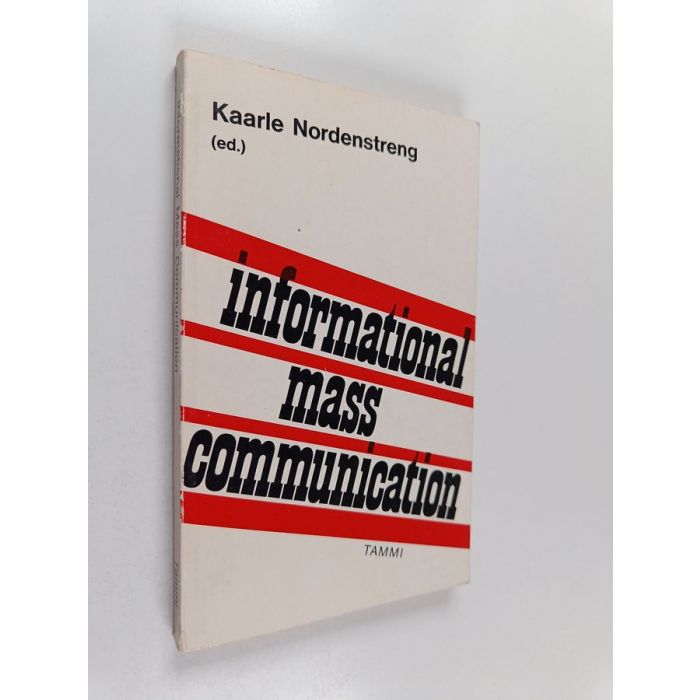
Kaarle Nordenstreng : Informational Mass Communication - A Collection of Essays
10,00 €
Varastossa
Vain %1 jäljellä
SKU
P-INFO-2A3FAA

Kaarle Nordenstrengin kokoelma esseitä avaa suoran näkymän suomalaiseen tiedotukselliseen ohjelmapolitiikkaan ja sen yhteiskunnallisiin jännitteisiin. Teos tarkastelee, kuinka tiedon vapaa leviäminen haastoi valta-asetelmat mediassa sekä politiikassa.
In the late 1960s some universally recognized tendencies and controversies became very clear in Finnish broadcasting. New people with new ideas brought the Finnish Broadcasting Company to the focus of attention of the Finnish people — and of all the political groups. The new ideas met with a hardening opposition from conservative interests.
The new philosophy was called informational programme policy. It was created in close co-operation between media practitioners and academic communication researchers. The point was to maximize the flow of true, new and important information, not to maximize the number of viewers, nor of believers.
The authors of this book, all of them more or less centrally involved in developing and executing the new policy, did not at that time fully see the potential threat felt by holders of power when faced with comprehensive information about society. Now, they see that the access to knowledge and information is one of the most important reasons why the ruling class has a monopoly of power and why the underprivileged lack power. Consequently, an attempt at maximal true information cannot be socially neutral but necessarily becomes 'partial'.
The 'Finnish approach' has awakened the interest of many broadcasters, communication researchers and students of journalism from various countries. The purpose of this book is to meet that interest and present the theoretical orientations and policy innovations in Finnish broadcasting to a wider public.
The new philosophy was called informational programme policy. It was created in close co-operation between media practitioners and academic communication researchers. The point was to maximize the flow of true, new and important information, not to maximize the number of viewers, nor of believers.
The authors of this book, all of them more or less centrally involved in developing and executing the new policy, did not at that time fully see the potential threat felt by holders of power when faced with comprehensive information about society. Now, they see that the access to knowledge and information is one of the most important reasons why the ruling class has a monopoly of power and why the underprivileged lack power. Consequently, an attempt at maximal true information cannot be socially neutral but necessarily becomes 'partial'.
The 'Finnish approach' has awakened the interest of many broadcasters, communication researchers and students of journalism from various countries. The purpose of this book is to meet that interest and present the theoretical orientations and policy innovations in Finnish broadcasting to a wider public.
* Kuvausteksti saattaa koskea teoksen toista versiota. Kuvauksessa mainitut yksityiskohdat, kuten mahdolliset oheistuotteet, eivät välttämättä ole osa valitsemaasi teosta. Valitsemasi teoksen tarkat tiedot löytyvät alla olevasta ominaisuusluettelosta.
| Tuoteryhmä | |
|---|---|
| Tekijä | Kaarle Nordenstreng |
| Teoksen nimi | Informational Mass Communication - A Collection of Essays |
| SKU | P-INFO-2A3FAA |